
Work ability
Work ability is a concept in which an employee’s health, competence and motivation are aligned with the demands of their job. An individual’s experience of demands also plays a key role in shaping their work ability.
Competence requirements are constantly evolving in the ever-changing world of work, and the significance of mental health for work ability has increased. Social factors, such as legislation and collective agreements, also influence job demands and thus work ability.
Comprehensive approach to work ability
Work ability can be assessed in different ways. For example, an assessment conducted to determine eligibility for services and benefits is based on an individual’s medical condition. In such cases, the focus is on the degree of incapacity for work rather than on work ability. Incapacity for work is determined on the basis of an illness, injury or disability.
When supporting work ability, however, it is examined broadly and a range of support measures can be used. In addition to supporting an individual’s health, competence and motivation, workplace-wide approaches can be used to support and manage work ability. Workplaces and supervisors should therefore have established practices for supporting employees’ work ability.
If an individual’s health and functional capacity have deteriorated, assessing their limitations alone is not enough. It is important to understand what work means to them and how they perceive their work ability. This enables comprehensive support and helps identify practical and realistic solutions.
Work Ability House
The broad concept of work ability can be illustrated by using the Work Ability House model developed by Professor Juhani Ilmarinen. The model is based on studies on factors affecting work ability.
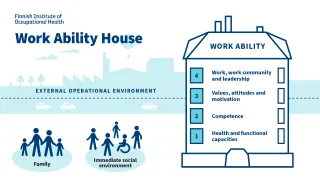
Digital and print-ready versions of the Work Ability House image can be downloaded in Finnish, Swedish and English from the Finnish Institute of Occupational Health image bank. You may adapt the image to suit your needs, but the source – the Finnish Institute of Occupational Health – must always be acknowledged when the image is used.
Cooperation strengthens the storeys of the Work Ability House
The Work Ability House is stable and functional when all its floors support one another. When a person, the job, or the work environment changes, it is important to ensure that the different floors of the house remain balanced.
Maintaining work ability and supporting continued employment are not solely the individual’s responsibility. Supporting work ability often requires multidisciplinary cooperation. The work ability of working-age people is supported by different actors, including occupational health care, employment services and rehabilitation service providers.
- Health and functional capacity form the foundation of work ability
- Together, physical, psychological and social functional capacity and health form the foundation for work ability.
- However, an individual’s functional capacity is not the same as their work ability. Even if functional capacity has deteriorated, its impact on work ability varies depending on the work duties and life situation.
- Competence is an increasingly important component of work ability
- Competence is based on an individual’s basic education and vocational knowledge and skills.
- Continuous updating of knowledge and skills is important.
- The importance of this storey of the Work Ability House has become increasingly evident in recent years, as work demands are growing and new kinds of competence are constantly required across all sectors.
- Meaningful work strengthens work ability
- An individual’s attitudes and motivation affect their work ability.
- If an employee feels that their work goes against their values or the work is not motivating, their work ability can be impaired. On the other hand, if the employee considers their work meaningful and suitably challenging, their work ability will improve.
- Work motivation is clearly linked to good working conditions, including fair management practices, appreciation, meaningful work content and well-organised work processes.
- Leadership, the work community and working conditions
- Good leadership and supervisory practices help ensure the smooth flow of work. This can be achieved by setting clear goals, influencing how work is organised and carried out, and improving working conditions.
- An open and respectful workplace culture fosters a sense of community, diversity and inclusion within the work community.
- Work ability management is part of day-to-day management that needs to take into account every storey of the Work Ability House (see the separate section on work ability management below).
- Family, close relationships and the operating environment affect work ability
- An individual’s immediate social environment can help maintain their work ability.
- Conversely, meaningful work with appropriately adjusted demands can provide support when, for example, a close family member’s serious illness affects an individual’s work ability.
- Societal values, attitudes and legislation also influence work ability
- Examples of societal factors that may also have an impact on an individual’s work ability include employers’ attitudes towards different types of employees and changes to legislation on working hours.
- The decline in physical labour and the rise of knowledge-based work place greater emphasis on mental resilience and flexibility at work. Societal change creates new opportunities for individuals, but the constant need to manage one’s own work can also become a burden.
Work ability management
Work ability management refers to goal-oriented, systematic activities aligned with the workplace’s strategy to support and improve work ability at both individual and work community levels. It includes proactive measures as well as support in changing circumstances. Successful work ability management requires close cooperation between various parties, including supervisors, management, HR, occupational safety and health professionals, and occupational health care.
Work ability management can be illustrated as a pyramid:
- Foundation: Day-to-day management ensures the necessary conditions for work and its smooth flow. The key is to identify and strengthen the resources of employees and the work community while preventing risks to work ability, health and safety.
- Middle level: Challenges that arise in the work, the working environment or the work community should be addressed promptly. Solutions should be sought jointly by the relevant parties, such as employees, supervisors, HR and occupational health care.
- Top level: Employees whose work ability has declined should receive support and tailored solutions that enable them to continue working or return to work.
Additional information about work ability
Work ability
- Supporting work ability at workplace guide (suomi.fi)
- From the disease-based assessment of work ability and functional capacity to a multidimensional assessment model (duodecimlehti.fi) in Finnish, only an abstract in English
- The concept of work ability in the research and practice of rehabilitation (helsinki.fi) in Finnish, only an abstract in English
- Dimensions of work ability: Results of the Terveys 2000 study (julkari.fi) in Finnish, only an abstract in English
- From work ability to work potential (ttl.fi) in Finnish
- Exploring the diversity of conceptualizations of work (dis)ability: a scoping review of published definitions (link.springer.com)
- The Concept of Work Ability (link.springer.com)