

In 2025, employees of the municipalities participating in the Kunta10 survey were absent from work for an average of 16 days due to their own illness. The amount corresponds to the level of the previous two years. Researchers encourage supervisors to follow-up on absences.
"An analysis of municipal sickness absence data has shown that sickness absence forms different patterns. Young employees are more likely to have recurring brief periods of absence, while older employees are more likely to have recurring long periods of absence," says Chief Researcher Jenni Ervasti from the Finnish Institute of Occupational Health.
“Supervisors should monitor both the number of sickness absence days and the pattern they form, so that the root causes can be identified and the means of reducing absences can be tailored correctly,” says Ervasti.
"A healthy lifestyle can protect employees against long periods of absence. For example, regularly commuting by bike improves fitness and reduces absences.
The Kunta10 study, conducted by the Finnish Institute of Occupational Health, has monitored the sickness absence of personnel in 11 municipalities since 2000. From 2023 onwards, the research team changed when the personnel of the social welfare and rescue services were transferred to the wellbeing services counties with the exception of Helsinki. The sickness absence rates of employees who have continued working for municipalities after the reform package on healthcare and social welfare seem to have remained at the previous level. (Figure 1.)
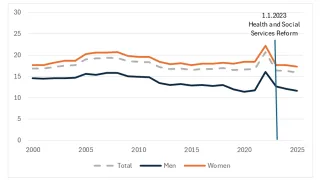
Figure 1. Development of sickness absences in the municipal sector in the 21st century. Full-time employees. Kunta10 study, Finnish Institute of Occupational Health.
Gender, profession and age have an effect on absence
The municipal sector is predominantly female, and in 2025, there were more sickness absence among women (17 days) than men (12 days). The difference between genders is also related to the gender distribution of professions, as there is still a strong gender division in municipal sector professions.
The socio-economic differences between occupational groups in sickness absence have remained stable: those in managerial and specialist positions have fewer sickness absence than those in physical, nursing and service work.
The largest occupational groups in the municipal sector after the reform package on healthcare and social welfare are female-dominated. In 2025, lecturers, part-time teachers, childcare providers, early childhood education employees and class teachers covered 40 per cent of the entire focus group, measured in person-years.
There are major differences in sickness absence between teachers; teachers working in schools have fewer absences than early childhood education employees working in daycare centres. Those working with children under school age are at higher than average risk of communicable diseases.
Of the predominantly male professions, construction and maintenance workers have a high number of sickness absences (21 days).However, the group is small (1 per cent of the entire focus group). (Figure 2.)
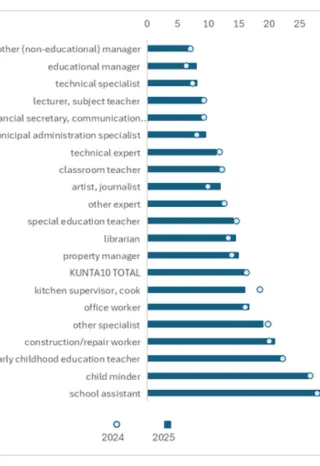
Figure 2. The average number of sickness absence days per person-year in 2025 and 2024 in the largest occupational group of the municipal sector (in 2025). Full-time employees. Kunta10 study, Finnish Institute of Occupational Health.
Number of sickness absences among young adults increasing
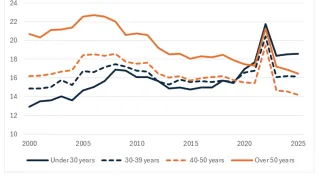
In the early 2000s, the number of sickness absences increased with age, but over the past five years this trend has almost completely reversed. Now, the youngest employees have the most sickness absence days, while the numbers have decreased for older employees. For example, municipal employees under the age of 30 had an average of 19 days of sickness absence per year, while the average for 40–50-year-olds was 14 days.
Long-term monitoring shows that the development of sickness absences among employees aged over 40 has been positive in the municipal sector. The increased number of sickness absences among younger employees may be partly explained by a cohort effect, meaning that the healthy 30-year-olds of the early 2000s are now healthy people in their fifties. (Figure 3.)
One in five municipal employees still avoid sickness absences
20 per cent of the personnel of the Kunta10 study municipalities did not take any sick leave due to their own illness in 2025. The share of employees who worked without any sickness absences has been declining over the long term, with the exception of the pandemic years.
The proportion of employees with zero days of sickness absence may reflect either the share of completely healthy employees or the prevalence of presenteeism, whereby employees continue working despite being ill. The change in the proportion of people with zero days of sickness absence may be influenced by factors such as the proportion of people with partial work ability, changes in the remote working policies or employment opportunities in municipal workplaces. (Figure 4.)
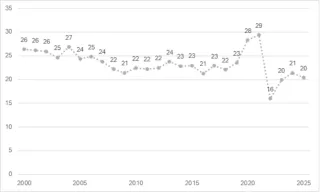
Figure 4. Percentage of employees with no sickness absence due to their own illness during the year, 2000–2025. Full-time employees. For employees with no sickness absence days, the analysis includes only those with at least six person-months of employment during the year. Kunta10 study, Finnish Institute of Occupational Health.
Kunta10 study
- The Finnish Institute of Occupational Health’s Kunta10 study is Finland’s largest follow-up study of municipal employees. The study involves Helsinki, Espoo, Vantaa, Tampere, Turku, Oulu, Naantali, Raisio, Nokia, Valkeakoski and Virrat.
- The annual sickness absences of more than 90,000 municipal employees is monitored from the personnel registers of employers in a uniform manner in proportion to the actual sickness absence days and the number of person-years worked. The follow-up has been continued since 2000.
- The statistics of the Kunta10 study cover all absences due to the employees’ own illness from the first day of absence, but do not include information on the reasons for sickness absences.
- The sickness absence statistics for 2025 are based on 73,730 person-years.
See the data in the Work-Life Knowledge service
- Sickness absences in Finnish municipalities | Work-life Knowledge | www.tyoelamatieto.fi
- The results of the Kunta10 study follow-up surveys can be viewed in the Work-life Knowledge Service (latest figures from 2024): Municipal work and employee well-being | Work-life Knowledge | www.tyoelamatieto.fi
Further information
- Jenni Ervasti, Chief Researcher, PhD, Adjunct Professor, Finnish Institute of Occupational Health, jenni.ervasti [at] ttl.fi, +358 (0)30 474 2806
- Sickness absence patterns and related factors: Patterns and correlates of sickness absence before and during the COVID-19 pandemic in a cohort of Finnish public sector employees | Discover Public Health | Springer Nature Link


