
Workshops on crisis recovery for the work community

Duration: Preparation by the workshop leader and 2–3 workshops (total duration about 6 hours).
Content: Three work phases and a leadership checklist for recovering after a crisis.
Outcome: Daily work is normalized to the extent that the work community can concentrate on working again.
- For whom?
For a work community (up to 20 people) that has encountered a situation that has shaken the general sense of safety and security, such as a data breach, change negotiations, flood, health threat or break-in at the premises. For supervisors, occupational safety and health actors and human resources specialists. - Benefits?
The workshops provide work communities with everyday means of recovering and carrying on their work. It guides the work community to address a shocking event in a way where everyone’s experiences are seen and heard. The series of workshops provides the work community with shared opportunities to go through what has been experienced and promotes returning to normal daily work.
Tips for using the workshops
- Workshops can be offered as a means of supporting teams in occupational safety and health personnel's training or meetings.
- The workshops are an excellent addition to the work community's development events after experiencing changes at the workplace.
- The method is a low-threshold tool for the work community. It can be used, for example, if you are wondering why people behave in unexpected ways or when a past incident keeps coming up in coffee-break conversations.
- The method is not suitable for very serious situations, such as dealing with the sudden death of a colleague.
Recovery may take a long time – the workshops help you move forward
When the work community has experienced something shocking, the experience occupies the work community’s attention for a long time. A shocking event may be, for example, a fire, data breach, accident or major crisis affecting society as a whole. Immediately after the event, all attention is focused on investigating the actual situation (response). If the situation is serious, executive assistance is also available, and crisis assistance is often offered at this stage to those who have been involved in the situation.
Experiencing a shocking situation and recovery from it are individual. People may also have been treated differently. The experience may have changed attitudes towards work, the workplace and the work community. After a shocking event, well-being at work and collaboration must be rebuilt.
The recovery workshops help the work community deal with a shocking event during early and long-term recovery. It provides ways of conducting discussions that make it easier to build daily life at work that has changed but is good for everyone.
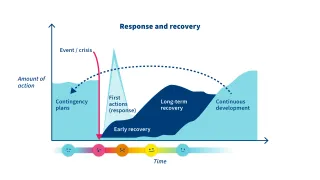
Picture. Progress of recovery. Source: McKay (adapted).
Work phases
In the recovery workshop method, work progresses through three main phases.
- Assessing personnel’s well-being: discussing how people experienced the situation and how they are doing now.
- Strengthening collaboration: paying attention to how the work community functions now and how it can be strengthened.
- Learning from the crisis: a shared discussion on what was learned from the crisis, what lessons learned will be made use of and how possible future crises can be prepared for better.
Before Phases 1 and 3, the participants carry out some independent work. In addition, the facilitator should reserve time for advance preparation.
Leadership checklist
Leadership plays an important role during the different stages of a crisis. Examine the diagram below and identify the leader’s most essential tasks during an unfolding crisis.
In all stages, it is important to actively communicate about the situation and listen to the employees. Emotions are part of working life, and especially during a crisis, it is important to face them genuinely and appropriately. Stress should also be monitored after the acute phase has ended. In addition, leaders’ own stress should be monitored and relieved.
Ask our experts

Miira Heiniö

Liisa Puskala

Kati Karhula

Mikko Halinen

Ilkka Asikainen